
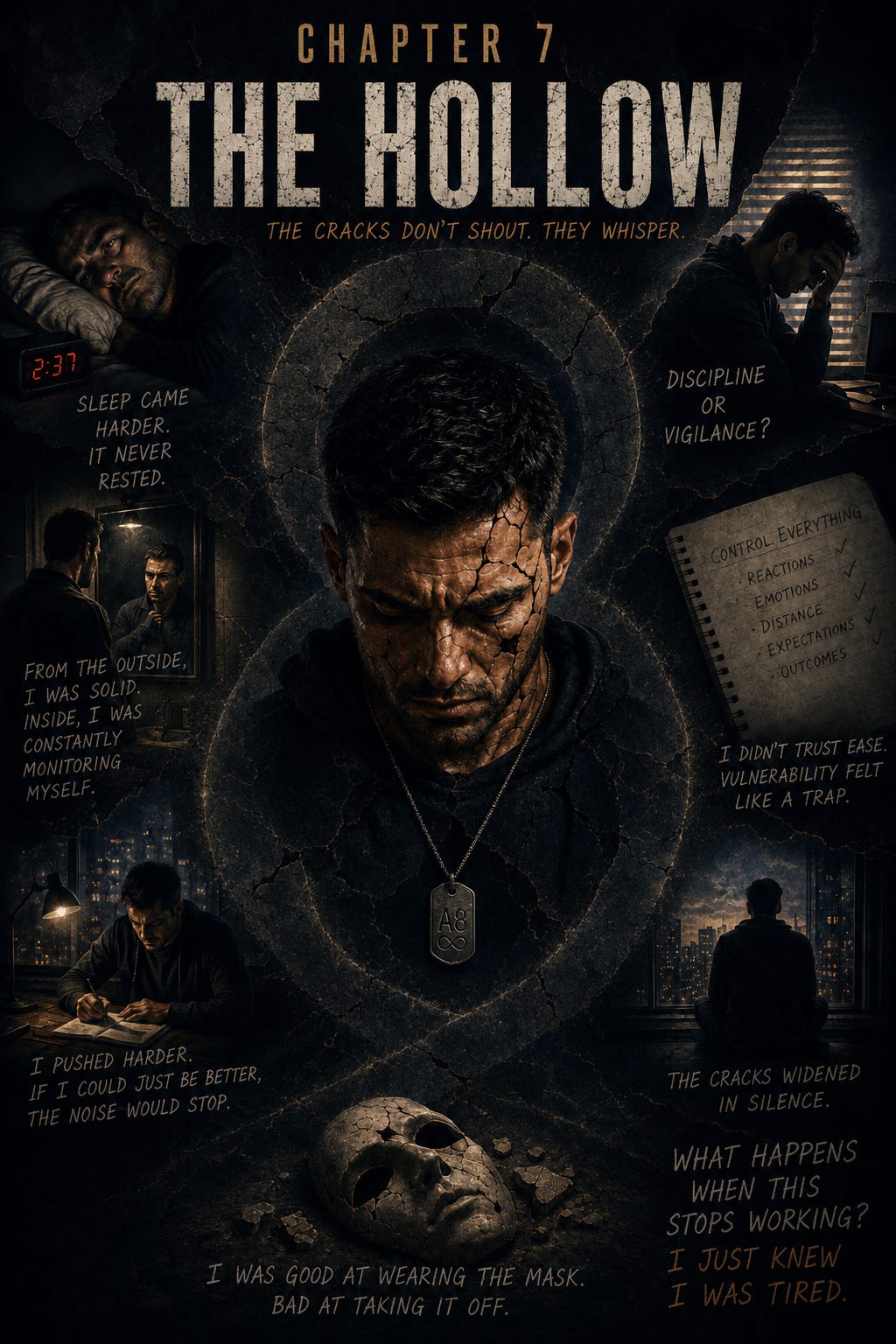
Chapter 7 — The Hollow
The cracks didn’t arrive all at once.
They never do.
They showed up quietly, in places I told myself didn’t matter. Shorter patience. Longer nights. A constant edge I couldn’t sand down no matter how tight my routines stayed. I was still functioning—still reliable—but it took more effort to hold the line.
Control was starting to feel heavy.
I noticed it in my body first. Sleep came harder. When it did, it didn’t last. I’d wake up already tense, jaw locked, shoulders tight, like I’d been bracing for impact in my dreams. My mind stayed alert even when everything else was still.
I called it discipline.
It felt more like vigilance.
People around me didn’t see anything wrong.
That was the problem.
From the outside, I was solid. Put together. Doing exactly what I was supposed to do. Inside, I felt like I was constantly monitoring myself—every reaction, every emotion—making sure nothing surfaced before I was ready to face it.
I didn’t trust ease.
When things went well, I waited for the cost. When people got close, I measured distance. Intimacy felt like risk. Vulnerability felt like stepping back into rooms I’d barely survived.
So I kept conversations surface-level. Kept feelings efficient. Kept myself contained.
That’s how you survive when you’ve learned that exposure invites damage.
But pressure doesn’t need chaos to break you.
Sometimes it just needs time.
On a Fourth of July, months before the fall, I had survived another accident that should have killed me.
My car caught fire while I was driving across a causeway.
I sent it over the edge trying to survive the flames.
Somehow, I lived.
I didn’t stop long enough to understand what it had done to me.
A tropical storm passed through shortly afterward.
The following week, I went back to DJing.
That was how I handled it.
I kept moving.
Music gave me somewhere to put everything I couldn’t explain. Behind the decks, there was no burning car. No water closing around me. No question of why I survived.
There was only the next record.
The next transition.
The next beat.
Then, only a few months later, the day before Thanksgiving, I fell approximately thirty-four feet from a ladder.
My face hit concrete.
My orbital bone shattered. My ribs fractured. My face required reconstructive surgery.
During that surgery, my heart stopped.
Flatline.
And somehow, again, I came back.
Seventy-two hours after they had put my face back together—still swollen, bruised, and barely recognizable—I went out and DJed a massive warehouse party.
Looking back now, I have to ask myself:
What the hell was I thinking?
At the time, it didn’t feel irrational.
It felt necessary.
After both traumatic events, I played the same records.
The records that had survived the fire.
The car burned.
I nearly drowned.
My body broke.
My heart stopped.
But the records survived.
So I kept spinning them.
Maybe some part of me believed that if the music kept playing, then I was still alive.
Maybe I needed proof.
Maybe I needed the crowd to see me standing so I wouldn’t have to admit how close I had come to never standing again.
Whatever the reason, people connected with what I was doing.
I didn’t get to practice alone like most DJs. Almost every night, thirty to fifty people would show up at my house. They would ask to stay, sit nearby, and watch me spin records.
At first, they watched.
Then I started teaching them.
Eventually, the nights became a challenge.
People would walk up and hand me any record—mine or theirs—with the expectation that I would beat-match it and mix it harmonically by ear.
They thought I was crazy when I first guaranteed I could do it.
Then they watched me do it.
Again.
And again.
It became my specialty.
I was surrounded constantly.
At the time, that looked like success.
And it was success.
But it was also protection.
The more people who filled the room, the less silence there was for me to hear.
I wasn’t avoiding life.
I was building one at full volume.
During the day, I worked full-time for a major financial institution.
I also attended community college, finally working toward an associate degree in business.
At night, I became DJ Alevy8.
There was always somewhere to be.
Someone to help.
Something to learn.
Something to teach.
Something to prove.
I didn’t slow down long enough to ask how one person was doing all of it.
I just did it.
People started looking to me for more than music.
Some of the guys were only a few years younger than me.
They came for the records, but sometimes it became obvious they were staying away from something else.
One of them showed up often with bruises and explanations that never quite matched what I could see.
He called me “Pops.”
Eventually, I understood enough to stop asking questions he wasn’t ready to answer.
The solution seemed simple.
Mi casa es su casa.
Problem solved.
I gave him somewhere safe to stay. Took him under my wing. Helped him become a local favorite behind the decks.
He even chose a DJ name that ended in the number eight.
That part was his idea, not mine.
I also encouraged him to take his real passion seriously. He eventually built a career around working on cars and racing them.
Then another young man entered my life.
He came from a good home and drove a nicer car than I did, but he lived a little farther north on the highway and was frequently in my city for the shows.
He crashed at my place often and started calling me “Daddo.”
At the time, I didn’t recognize the pattern.
Young men kept showing up.
They came for the music, but some of them stayed because the house had become something else.
A refuge.
A place where they could belong.
A place where someone believed in them.
Years later, I would understand that they saw me as a father figure before I fully understood how much of myself I was pouring into that role.
Maybe helping them gave me a purpose strong enough to keep my own questions quiet.
Maybe protecting other people was easier than looking directly at what I was carrying.
Either way, I became very good at being needed.
Everything grew quickly.
Before I knew it, I was playing alongside some of the world’s best DJs and performing at major events.
The doors were opening.
The momentum was real.
Little did I know, life had another direction in store for me.
Something I now understand as a blessing in disguise.
From the outside, it looked like everything was lining up.
A career taking shape.
A house full of people.
A growing audience.
A full-time job.
College.
Mentorship.
Music.
Purpose.
Everything was happening exactly as it was supposed to.
And I believe that.
The success was real.
The relationships were real.
The music was real.
The people I helped mattered.
But something else was real too.
I had built a life where I was almost never alone long enough to process the fact that I had nearly died twice.
I didn’t isolate after the trauma.
I did the opposite.
I surrounded myself with people constantly.
I filled every room.
Every hour.
Every silence.
The hollow didn’t look empty.
It looked full.
Full of music.
Full of people.
Full of responsibility.
Full of applause.
Full of proof that I was still alive.
Little things still started to set me off—not outwardly, not in ways anyone could easily point to—but internally.
A comment that hit too close.
A situation I couldn’t control.
A reminder that no matter how disciplined or successful I became, the past had never asked permission to follow me.
I didn’t explode.
I imploded.
I worked harder.
Pushed further.
Tightened my grip on everything I could reach.
If I could just be better—stronger, sharper, more precise—then maybe the noise would finally shut up.
It didn’t.
The cracks widened in silence.
In the rare moments alone.
In the gap between who everyone believed I was and what I actually felt underneath it all.
I was becoming good at wearing the mask—
but bad at taking it off.
And somewhere underneath the structure, underneath the music, underneath the crowds, underneath the control, the same question kept surfacing:
What happens when this stops working?
I didn’t have an answer yet.
I only knew how to keep the room moving.
Keep the records spinning.
Keep showing up.
Keep being the person everyone needed.
Because as long as the music played, I didn’t have to hear the silence.
And as long as the room stayed full, no one could see the hollow.
Not even me.
—End of Chapter 7—