
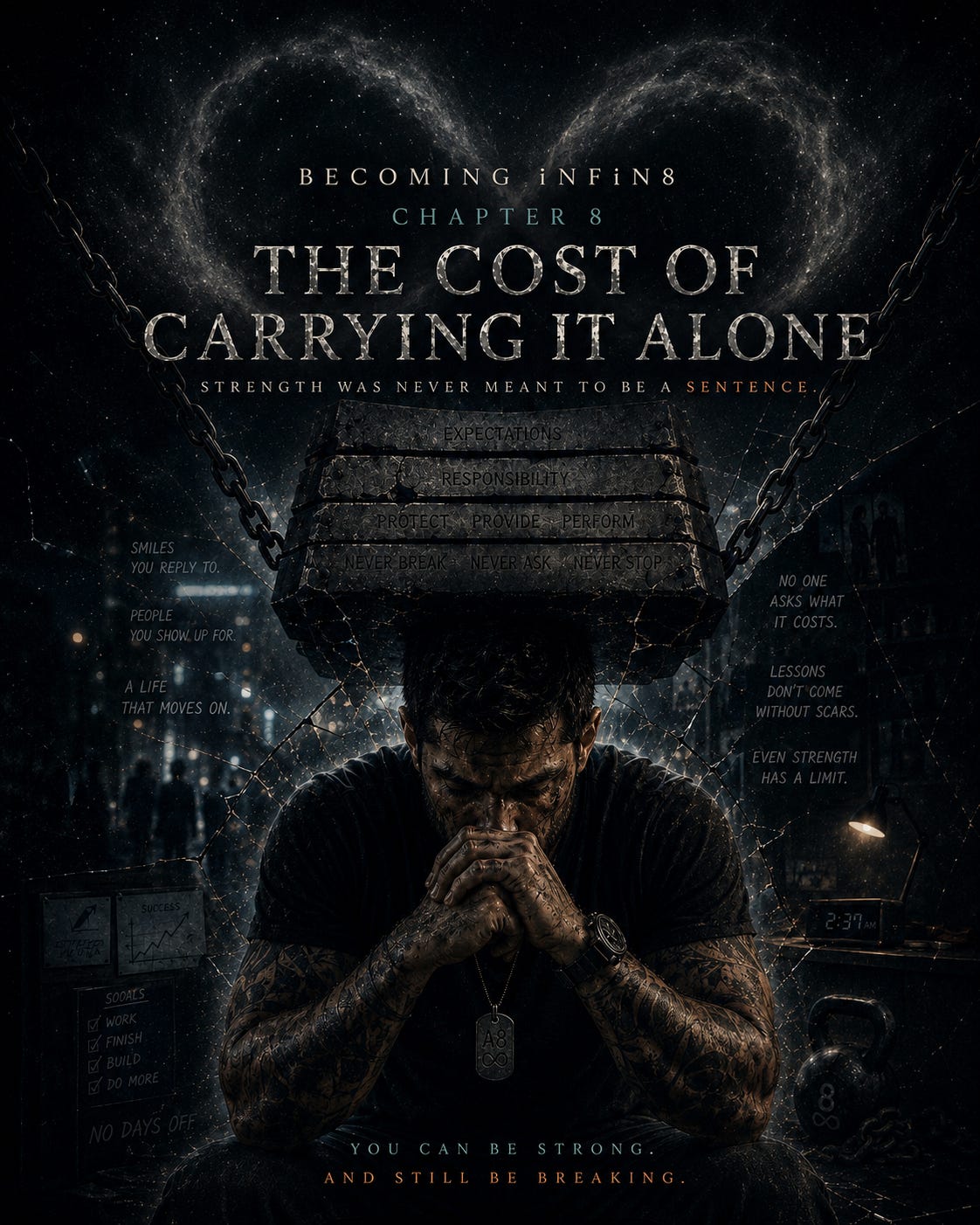
Chapter 8 — The Cost of Carrying It Alone
There’s a point where strength stops feeling strong.
For me, it didn’t arrive with a breakdown or a dramatic moment anyone else could see. It came as exhaustion so deep it felt structural—like something inside me had been carrying weight for too long and finally started to bend.
People often ask when everything changed.
They expect me to point to a single day, a single diagnosis, or a single tragedy.
Life doesn’t usually work that way.
It changes one compromise at a time.
For years, I had built a life that looked impossible from the outside. I had survived things that should have broken me. I became a Neuro ICU nurse after being told I probably never would. I found purpose helping people through the worst days of their lives. I was married. We had a beautiful daughter.
For the first time in a long time, I wasn’t just surviving.
I was living.
Then, almost as quickly as it had come together, it began to unravel.
The marriage ended. The home I thought would last forever became another memory. The family I had worked so hard to build was suddenly divided.
I didn’t realize it then, but that was the moment something inside me quietly changed.
Not my love.
Not my determination.
My trust.
I stopped believing anything permanent could stay.
So I did what I had always done.
I worked harder. I pushed further. I stayed busy enough that I never had to sit alone with my thoughts.
I was still doing everything right. Showing up. Performing. Meeting expectations. But it took more out of me each time. The margin I used to have was gone. Everything required effort.
Even rest felt like work.
I didn’t talk about it.
I had learned early that explaining pain didn’t make it lighter. It only made it visible.
And visibility had never felt safe.
So I handled it the way I handled everything else.
Alone.
Isolation isn’t always physical. Sometimes it’s emotional. Sometimes it’s deciding, over and over again, that no one needs to know what you’re carrying. I kept people close enough to function, but not close enough to truly see me.
That’s the cost of self-reliance taken too far.
Then my body interrupted the plan.
What began as pain became something no amount of determination could overcome. For four weeks, I was misdiagnosed while the pain became almost unbearable. When the true problem was finally discovered, everything changed overnight.
Emergency surgery.
Twenty-four hours.
That was all I had to prepare.
Power of attorney.
A will.
Conversations no young father imagines having while his daughter isn’t even old enough to understand what is happening.
I knew the surgery was serious. I knew there were risks. But I wouldn’t understand how close I had come to losing everything until years later, when my physical therapist showed me the scans.
My cervical disc had split into multiple pieces.
One fragment had stopped only a fraction of a millimeter from my spinal cord.
The surgery hadn’t simply relieved the pain.
It had saved my life.
When I woke up, the instructions were simple.
Don’t lift more than five pounds.
Rest.
Heal.
For at least three months.
Those words sounded simple.
To me, they felt impossible.
My daughter was too young to understand why Dad couldn’t pick her up. She didn’t know why I couldn’t chase her through the house or carry her when she reached for me.
She only knew I was there.
That became enough.
I wasn’t fighting because I was fearless.
I was fighting because she deserved a father.
On the days I couldn’t find a reason to keep moving for myself, I could always find one for her.
She needs me.
That thought became stronger than the pain.
There was another loss I rarely talked about.
It wasn’t visible on an MRI.
It wasn’t written in the surgical report.
Growing up, singing was everything to me. Long before I stood behind DJ booths or worked beside hospital beds, music lived inside me. My voice was one of the few places I always felt completely free.
I once had a six-octave range.
After surgery, I knew something had changed.
The procedure had saved my life, but the retraction around my throat had damaged my vocal cords.
When I tried to speak, I sounded almost unrecognizable.
High.
Weak.
Almost childlike.
Like a chipmunk.
I was supposed to begin formal vocal therapy to prevent losing my voice completely. But I was nearly a thousand miles from home, staying with family while I recovered, and there were no specialists close enough for me to receive the therapy I needed.
So I improvised.
I started over.
Like a child learning to speak for the first time, I practiced every word. I slowed down and focused on annunciation. I worked through consonants, then vowels, repeating them until the sounds became clearer.
Little by little, words became sentences.
Then one day, almost without thinking, I caught myself humming.
Then singing.
The six-octave range I once had was gone. Maybe only a couple octaves remained.
But something far more important had returned.
My voice.
Not the one I used to have.
The one I had earned.
Sometimes healing doesn’t mean getting back what you lost.
Sometimes healing means learning how to create something beautiful with what remains.
Even while my body was forced to be still, my mind never stopped running.
For the first time in my life, there were no twelve-hour shifts. No patients. No crowds. No music loud enough to drown everything out.
No distractions.
Just silence.
And in that silence, everything I had outrun for years finally caught me.
The accidents.
The losses.
The fear.
The trauma.
The moments I never allowed myself to feel because surviving always seemed more important than healing.
I had been diagnosed with PTSD, but I still became a nurse when people told me I couldn’t. I built a career. I built a marriage inside the church. I built what I believed was finally a family.
My daughter had a mother.
I had a home.
I had purpose.
Then, almost overnight, the career I had worked so hard to earn was gone. The marriage was gone. The family I thought I had finally secured was divided.
And for the first time, I had nothing but time to think about it.
That was the part I had never prepared for.
I knew how to survive chaos.
I didn’t know how to sit still after it.
The anger I had disciplined never disappeared. It simply became quieter. It turned inward.
When things went wrong, I didn’t blame the world.
I blamed myself.
For not anticipating.
For not controlling.
For letting the cracks show.
I held myself to standards that left no room for being human.
I had mistaken endurance for recovery.
I had confused performance with peace.
I thought because I could still function, I must be okay.
I wasn’t.
And the body keeps score.
Years later, more medical emergencies would follow. Blood clots filled both lungs and nearly killed me. Severe pneumonia came next. Then another emergency surgery after my gallbladder failed.
Each event seemed separate at the time.
Looking back, they were all telling me the same story.
The body speaks long before the mind is willing to listen.
I spent years training my body to failure because I believed that was strength. I ignored pain because someone else always had it worse. I minimized my own struggles because complaining felt like weakness.
Stop complaining.
Everyone goes through things.
Other people have it worse.
I wore exhaustion like a badge of honor.
“I’ll sleep when I’m dead.”
For years, I believed that sentence made me disciplined.
It didn’t.
It made me deaf.
Fatigue became constant. My patience thinned. Sleep was one of the first things I sacrificed, followed by my health, my hobbies, and eventually my relationships.
The joy I thought I had outgrown turned out to be something I had shut down.
Life was happening, but I often felt as though I were watching it from behind glass.
Present.
But not participating.
I told myself this was adulthood.
Responsibility.
Maturity.
Strength.
Deep down, I knew better.
I wasn’t healed.
I was holding.
And holding takes energy.
Every day I spent keeping everything contained was another day I wasn’t fully living. I didn’t know what the alternative looked like. I only knew I couldn’t keep carrying everything this way forever.
Something was going to give.
I just didn’t know whether it would be my body, my relationships, or the identity I had built to survive.
Eventually, I understood the pattern.
First, my body lost alignment.
Then my mind followed.
Finally, my spirit lost its alignment too.
Like dominoes.
One after another.
The hardest part wasn’t losing my career.
It wasn’t the surgeries.
It wasn’t even the marriage.
It was realizing I no longer recognized the person carrying all of it.
After the family I had always wanted split apart, something inside me stopped trusting completely.
I could still love.
I could still help.
I could still show up for everyone around me.
But I no longer believed it was safe to depend on anyone staying.
So I became even more self-reliant.
More capable.
More prepared.
More difficult to reach.
I kept people close enough to know me, but not close enough to hold anything that could break me if they left.
At the time, I called that strength.
It was protection.
And protection, carried too long, becomes another kind of prison.
That realization changed everything.
I stopped trying to outwork my pain.
I started trying to understand it.
I stopped asking,
“How much more can I carry?”
I started asking,
“What do I finally need to put down?”
The answers didn’t arrive all at once.
Healing never works that way.
It came through small moments of honesty. Through learning that rest wasn’t surrender. Through recognizing that pain didn’t become invalid simply because someone else had suffered too.
Little by little, my body began healing.
My mind became quieter.
My spirit slowly found its way home.
For the first time, I understood that healing wasn’t a destination.
It was a discipline.
Not something that happened to me.
Something I had to choose every day.
I wasn’t rebuilding the life everyone else expected me to have.
I was beginning to build one that was actually mine.
I thought learning to stand again would be the hardest part.
I hadn’t yet realized…
I was still wearing a mask.
—End of Chapter 8—